WorkCase study
From proposed navigation to migration confidence
How I benchmarked a UX-led information architecture update against the existing experience, identified where the new model still created confusion, and helped the team determine which areas were ready to migrate into a broader enterprise platform.
- My role
I defined the research strategy and success criteria, evaluated the proposed information architecture against the existing experience, identified where the model was ready to migrate, and helped the team keep unresolved areas open rather than turning uncertainty into platform navigation debt.
- Team
UX, product, architecture, and platform stakeholders.
- Timeline
a two week research sprint.
- Core constraint
The team needed to keep the migration moving while parts of the proposed information architecture were still not understood well enough to treat as resolved.
The navigation also had to work within existing platform and technical constraints, which limited how freely some concepts could be reorganized.
- Strategic decision
I recommended that we stop treating the proposed IA as an all-or-nothing replacement.
Where research gave us enough confidence, we could move forward.
Where terminology, ownership, or the underlying product model still created ambiguity, we would keep the work open rather than turning uncertainty into platform-level navigation debt.
Confidentiality note: Product terminology, research data, navigation structures, interface details, and implementation specifics have been anonymized, modified, or recreated. Visuals have also been modified and presented at a lower resolution, while remaining representative of the original work and workflow.
Intro
The existing network services experience had an information architecture that customers had been using for years.
As the experience was prepared for migration into a broader enterprise platform, UX developed an updated IA with guidance from the product team. The proposed structure reflected a better understanding of the platform, product boundaries, and underlying systems.
But a more intentional structure was not automatically a better one for users.
Before the proposed IA became the model carried into the enterprise platform, I wanted to understand how it performed against the navigation customers already knew.
I led research comparing the existing and proposed structures through tree testing and usability testing, using task success, completion time, first-click accuracy, and backtracking to understand where each model helped or hindered people.
The results were mixed.
The proposed IA improved navigation in some areas, but it did not resolve the experience as a whole. Users still struggled with terminology, grouping, overlapping concepts, and parts of the product model that were difficult to understand regardless of where they appeared in the navigation.
That changed the migration decision.
Instead of treating the proposed IA as one validated replacement, I helped the team separate the sections we understood well enough to move from the sections that still needed discovery.
The initial implementation moved forward with the areas where research gave us sufficient confidence. Areas with unresolved terminology, grouping, or product-model questions remained open for further discovery rather than being carried into the new platform prematurely.
Impact at a glance
Migration scope changed
Research influenced what moved into the first implementation.
The proposed IA was not treated as universally validated
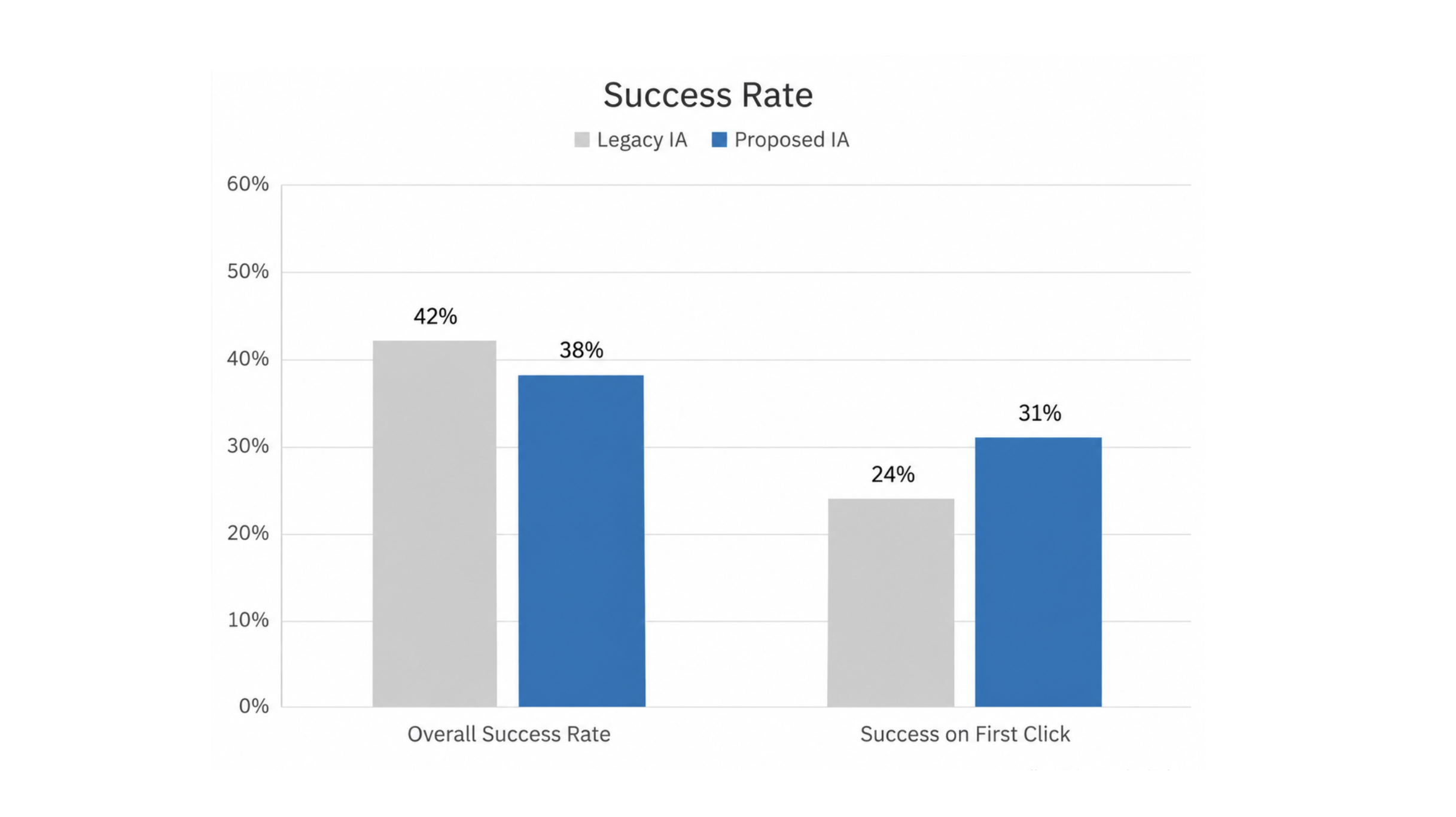
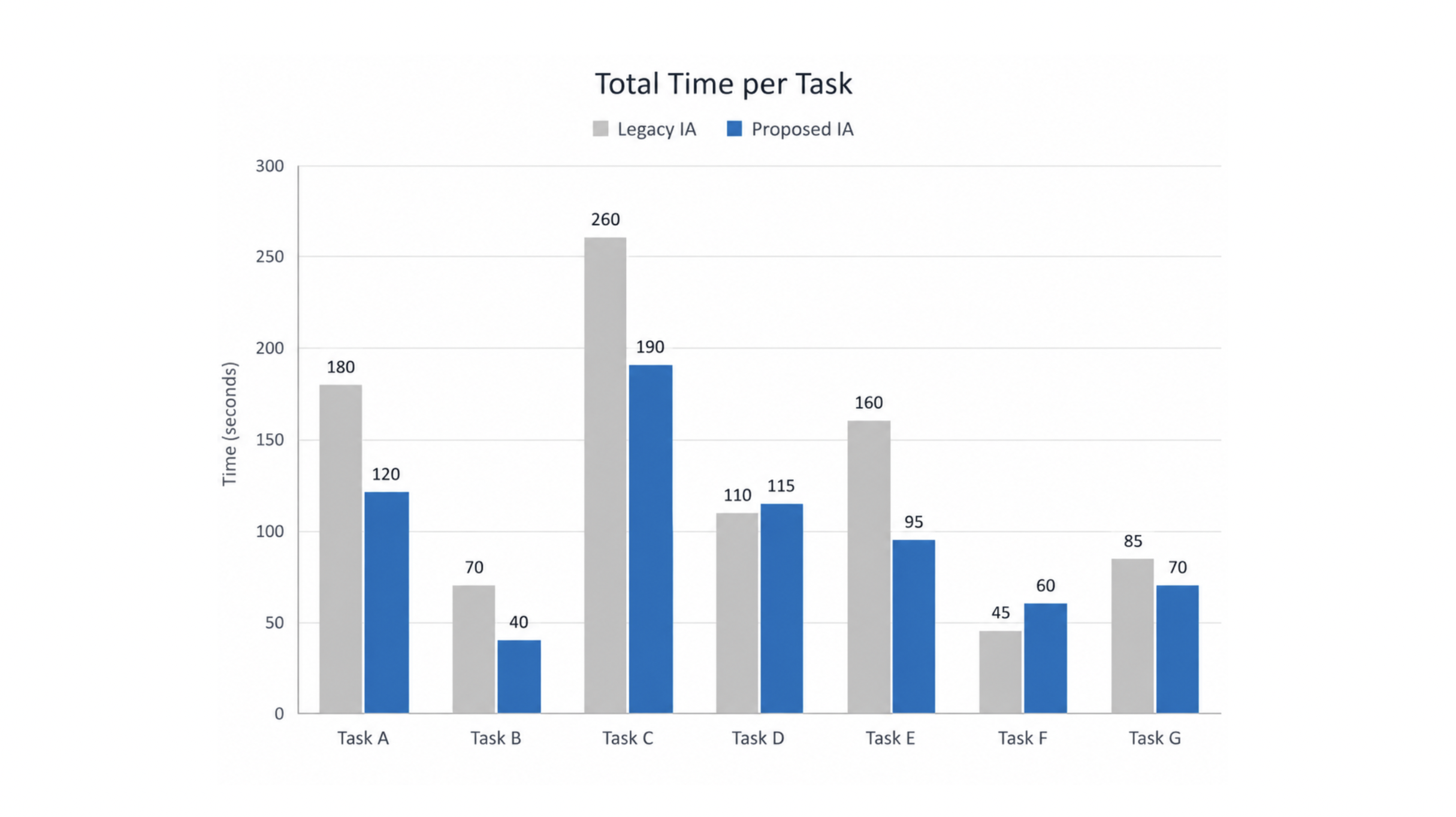
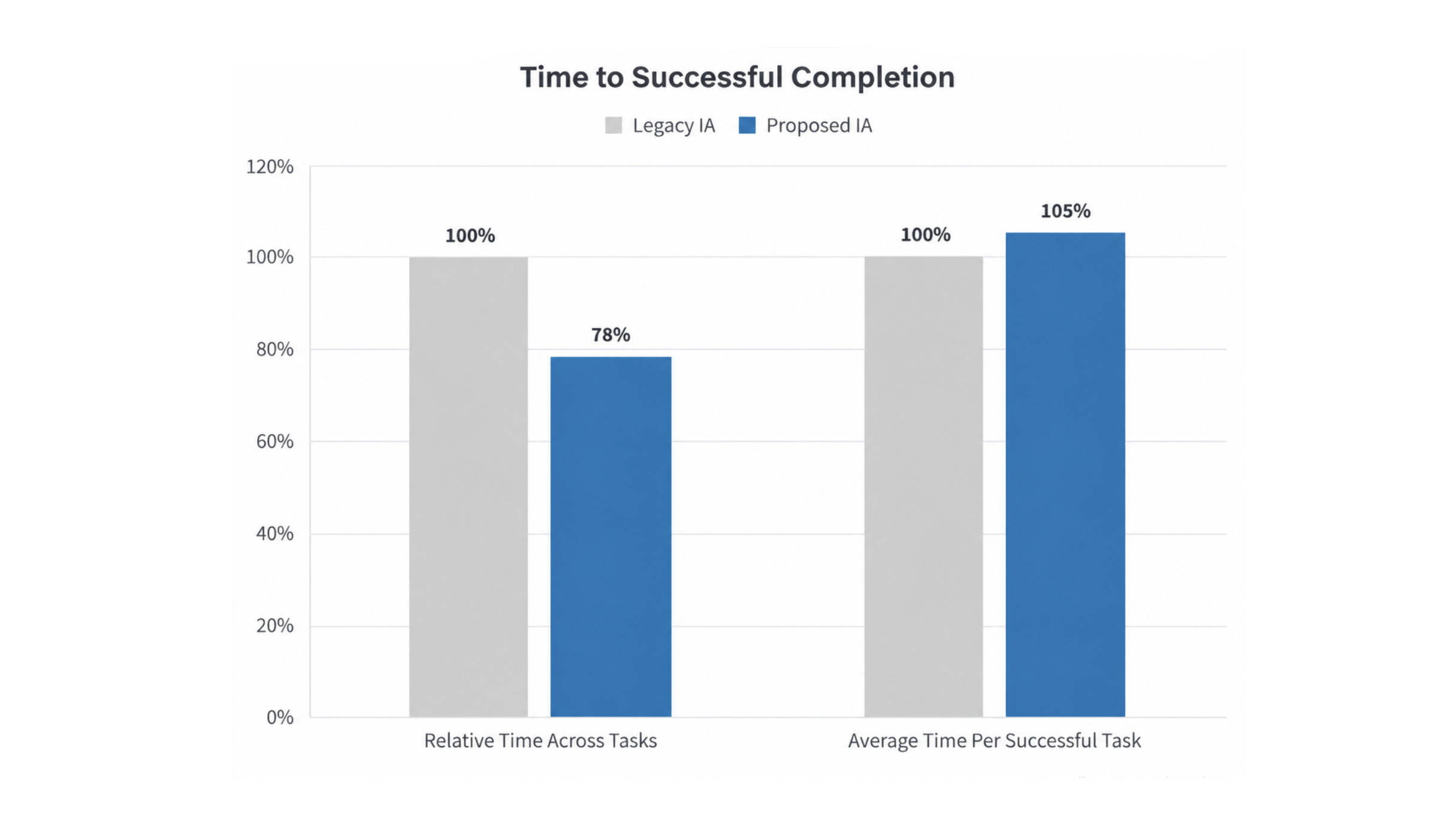
The comparison showed stronger completion efficiency and first-click behavior in parts of the proposed structure, but those improvements were not consistent across the entire navigation model.
The research gave the team a more precise view of where confidence existed and where it did not.
Navigation problems became product questions
Several areas of confusion could not be solved simply by moving menu items or rewriting labels.
Research exposed deeper questions around terminology, product boundaries, ownership, and the relationship between technical architecture and the way users understood their work.
The migration roadmap gained an evidence threshold
The team had a clearer basis for deciding whether a section was ready to scale:
not whether a proposed structure existed, but whether we understood it well enough to commit to it.
What I am not claiming
I am not claiming that the proposed IA was universally better than the existing one.
Testing showed improvement in some areas and continuing confusion in others.
The outcome of the work was therefore not a fully validated replacement navigation model. It was a more informed migration strategy: move the areas supported by enough evidence, and continue investigating the areas that were not.
We were comparing two models, not designing navigation from scratch
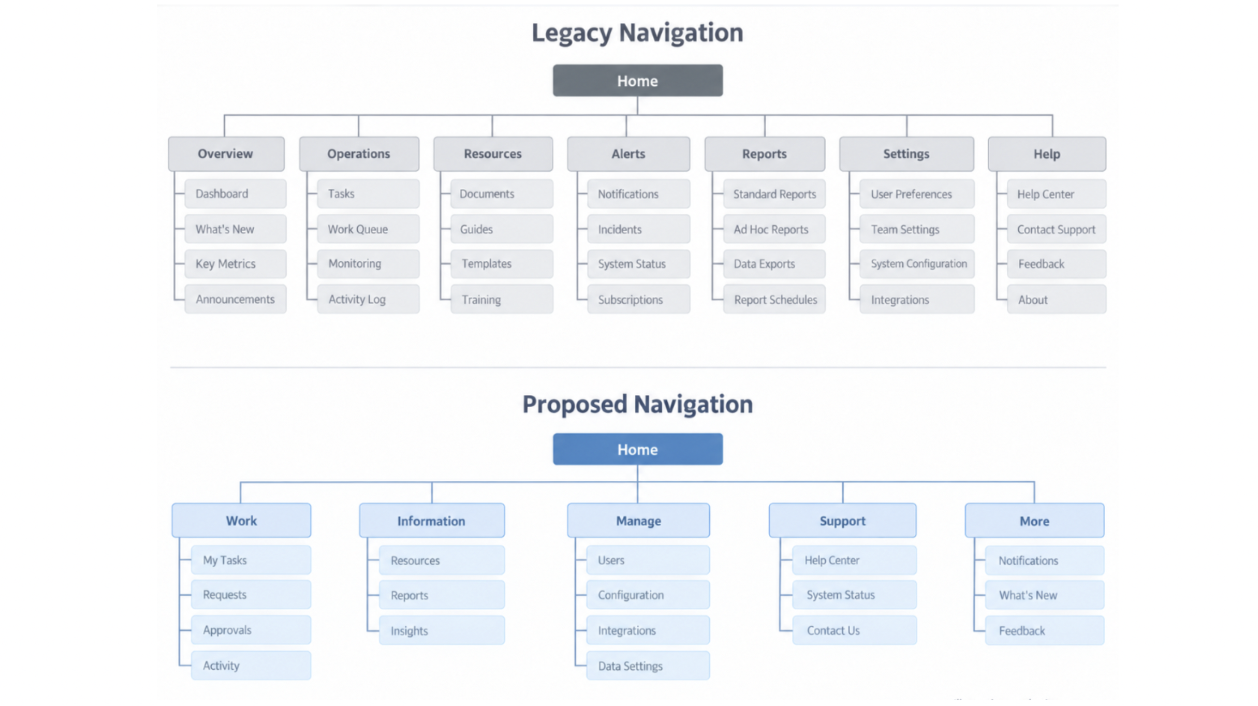
An existing network services product IA had accumulated over time.
It reflected several things at once:
- product history,
- back-end systems,
- platform architecture,
- team ownership,
- and user-facing terminology.
UX had developed a proposed update with input from Product to make that structure more coherent before the move into the enterprise platform.
The research question was therefore not simply:
“How should we reorganize the menu?”
It was:
“Does the proposed model actually help users understand and navigate the product better than the model they already have?”
Users already struggled with closely related concepts.
Those problems could appear to be navigation issues, but the research suggested that several of them went deeper.
A wrong first click might mean two labels were too similar.
It might mean internal terminology had leaked into the interface.
It might mean two legitimate mental models were competing.
Or it might mean the product itself contained concepts whose ownership or relationship was unclear.
The migration created a useful decision point because it forced us to ask which of those problems we were comfortable carrying into a broader platform.
The comparison needed to tell us more than which tree performed better
I combined stakeholder interviews, tree testing, behavioral metrics, and iterative IA prototypes.
Each method answered a different part of the question.
Stakeholder conversations helped me understand what the proposed structure was trying to represent: architecture, ownership, terminology, expected migration behavior, existing workflows, and technical relationships.
Tree testing let me compare the existing and proposed models directly rather than evaluating the proposed IA in isolation. It helped me see where users hesitated, backtracked, selected the wrong destination, or used language that revealed a different mental model from the one represented in the navigation.
I tracked task success, completion time, first-click accuracy, and backtracking because I wanted to understand not only whether someone eventually arrived at the right place, but how predictable that destination felt.
That distinction became important.
A successful task completed after hesitation and recovery did not tell the same story as a confident first click.
The proposed IA was better in some places, not across the board
The comparison did not produce one clear winner.
Some tasks in the proposed IA showed stronger navigation efficiency and first-click performance.
Other parts of the model continued to create uncertainty.
An improvement in one section did not prove that the entire proposed structure was ready to become the new platform model.
The research instead revealed different levels of confidence across the IA.
Some sections were understandable enough to move.
Others still contained terminology, grouping, or conceptual problems that needed more work.
That made the proposed IA less useful as a single pass/fail artifact and more useful as a way to identify where the product was stable and where ambiguity remained.
Some navigation problems were really product-model problems
A technically precise label could still fail if users did not recognize the concept behind it.
A familiar label could create the opposite problem if it hid an important distinction in the system.
That meant the work could not be reduced to finding better words.
The navigation needed to help users predict where an object, action, or task belonged.
When it could not do that reliably, I treated that as a signal to investigate the underlying concept rather than immediately trying another label.
The research changed how we thought about migration readiness
The migration timeline created pressure to finish the navigation and move the entire experience into the enterprise platform.
Research suggested that would create false certainty.
The proposed structure was more stable in some areas than others.
With a short research window, a small participant sample, and limited time for additional validation, I did not think the responsible recommendation was to keep iterating until every section appeared finished.
Instead, I separated the navigation between enough confidence to move forward versus more discovery needed.
That was a tradeoff between migration completeness and migration confidence.
Completing the full IA might have created a cleaner delivery story.
It also would have asked the organization to commit to decisions that the research had not fully supported.
Holding work back was part of the design decision
The research changed the migration roadmap.
That meant UX influenced:
- what moved,
- what did not,
- where the organization needed more evidence,
- and where migration effort should be invested first.
For me, that was an important part of the work.
Design does not always create value by resolving everything before a deadline.
Sometimes the more useful contribution is identifying where the team understands the problem well enough to act and where it does not.
That gave the team a clearer basis for deciding what it could responsibly scale.
Reflection
The most important contribution I made was helping the team distinguish between a proposed information architecture and a validated one.
UX and Product had good reasons for updating the existing structure. The proposal reflected a more deliberate understanding of the platform and how its capabilities fit together.
Research still needed to determine whether that model made sense to the people using it.
The answer was not simply yes or no.
Some parts of the proposed IA gave users a clearer path.
Other sections continued to expose terminology, ownership, and product-model problems that navigation alone could not solve.
That changed how I thought about the migration.
The goal was no longer to finish a replacement IA and move it into the enterprise platform.
It was to understand where we had enough confidence to commit, where we needed to make changes, and where the responsible decision was to keep learning.
By separating those areas, I helped the team move the migration forward without treating unresolved navigation decisions as finished work.
The project reinforced an approach I use often on complex systems: certainty should be earned before it is scaled.